
Nav
Classrooms & Conference Rooms

LOW-1050

LOW-1215

LOW-3000 and LOW 3025

LOW-1135, LOW-3015 and LOW-3040

LOW-3135

LOW-3057

LOW-4050

Computer Labs

Computers and Laptops

Computer Audio – Selecting Speakers

Driver Updates

Laptop Stands

Lenovo X1 Yoga – Battery Reset

Lenovo X1 Yoga – Camera Shutter

Lenovo X1 Yoga – Docking Station

Lenovo X1 Yoga – Increase Battery Life

Lenovo X1 Yoga – Monitors Not Working

New Computer Setup

Power Settings on Laptop

RDP vs. VPN

Remote Desktop

RIT Wireless Network

Running Hardware Diagnostics

Windows Updates from Microsoft

Email and Calendar

Adding a shared Exchange mailbox

Automatic Replies (Vacation Message)

Creating A Meeting Invite

Email Signatures

Filter all Meeting Requests and Updates to another folder

Forwarding Email Headers

Junk Email & Spam

Mailing Lists

Saunders Activities Calendar

Sending email from another account

Setting up the Outlook app on Mobile Devices

Sharing and Opening a Shared Calendar

Equipment Reservations

Executive MBA Support

EMBA Slack

File Services

Google Drive File Stream

OneDrive

Help Articles

Capstone Servers

Events Management System

Getting Software

How to screen share an iOS device in a Desktop Zoom meeting

Improve the speed of your iPhone/iPad

LanSchool Teacher Console Issues

PDF Printing Is Very Slow

Reset Outlook Search Index

Saunders Q&A Wednesdays

Schedule a Zoom Meeting on Behalf of Another

Inside.SCB & Sedona

Policies and Forms

PaF – Access to Offices

PaF – Data Store Policy

Printing and Scanning

Saunders Student Printing

Service Requests

Software and Databases
Adobe Software

How to Fix Adobe Serial Number Problem

Setting Up Certificate-Based Signatures in Adobe Acrobat

AI Tools

ATLAS.ti

Avaya Cloud Office Phone System

Handset Instructions

Azure Dev Tools for Teaching

Bizagi Modeler

Bloomberg

CrashPlan

Dedoose

EMS Desktop Client

FASB

Google Apps at RIT

Google Jamboard

Home Use

HubSpot

Ivanti

Force a Security Scan

Force an Inventory Scan

Portal Manager

KeePass

Leximancer

Microsoft Office

Microsoft OneNote

Microsoft Whiteboard

Overleaf

Password Managers

Qualtrics Surveys

RIT VPN Client

SAP

Slack

Spirion

SPSS

Stata

Tableau

Web Browsers

Browser Extensions

Browser Sign-In

Changing the Default Search Engine

Clearing the Browser Cache and Cookies

Disable YouTube Auto Play

Edge URL Copy and Paste

Recommended Browsers

Windows 10

Weathers & News Taskbar

Windows 10 – Default Applications

Windows 11

Windows 11 – Cannot Delete Public Desktop Icons

Windows 11 – Default Applications

Windows 11 – Start Menu & Taskbar

Windows 11 – Time Zone is Wrong

WRDS

Zoom

Zoom – Automatic Transcriptions

Zoom – Closed Captioning

Zoom – Remote Support

Zoom – Using Google Drive to Store Recordings

Zoom – Share Recordings

How-to articles

Capstone Servers

Table of Contents

Overview

These are generic instruction on how to set up Capstone Servers.  Please review the instructions that pertain to your server’s configuration.

If you have any questions, please feel free to contact Saunders Technical Support for assistance.

RedHat Apache Server

Usernames/Passwords

You will receive a text file via RIT File Exchanger that includes usernames, passwords, and hostname information. Be sure to keep this information in a safe, encrypted space.

Setting up your account

Do this step before any other steps.

To ensure the files you create on the server will be accessible by your teammates, you need to reconfigure your account on the server.

You only need to follow these instructions once and each member of your team must do so as well.

Start by ensuring you are on campus or using the RIT VPN Client (https://vpn.rit.edu).

SSH into your server’s hostname using Command Prompt in Windows or Terminal in macOS.  The commands are the same once you have opened that particular program.

C:\>ssh username@hostname

When you connect for the first time, you will see a notice asking you to accept the security certificate.  Type in yes and press enter.

The authenticity of host '********.main.ad.rit.edu (***.***.***.***)' can't be established.
ECDSA key fingerprint is SHA256:*******************.
Are you sure you want to continue connecting (yes/no/[fingerprint])?

You should then be prompted for your password.  Enter it and press enter.

Once signed in, type the following command:

nano .bashrc

Add to the end of the file umask 002
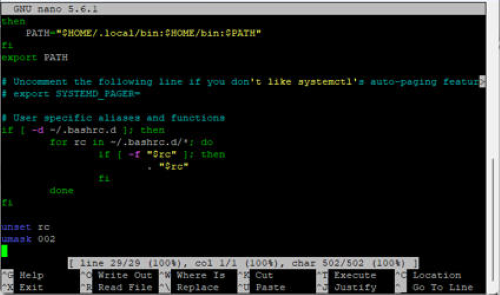
Press Ctrl-X and then Y to save your changes.

Be sure to log out by typing in exit and press enter.

Your account is now configured properly.

Accessing your web files

Your team’s web files are located in the directory /home/web/html

Any files you place here will be open to the RIT web community.

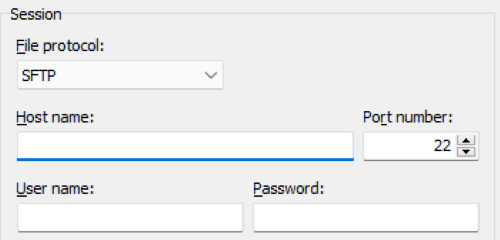
You can use tools like WinSCP to log into the server and access those files.

When connecting, use SFTP as the protocol on port 22.  The hostname will be the name of your server.
Accessing your database

Access to your database is done through a web interface. Please go to https://HOSTNAME/phpmyadmin to access your database.

Please make sure you create a database service account for any code that needs to access the database. Do NOT use the admin credentials that were provided to you.